


Preparing your child for the 11+ is a marathon, not a sprint, and comprehension is one area where steady, consistent progress pays off.
For many children, it’s the part of the English paper that feels the most unpredictable. After all, you can practise spelling rules or times tables until they’re automatic. But what about facing an unseen passage from Dickens, or a tricky non-fiction text about volcanoes?
The good news is comprehension isn’t a mystery. With the right strategies, children can confidently approach any passage and give examiners the precise, well-evidenced answers they’re looking for.
In this blog, we explain exactly what comprehension means for the 11+, question types, how children build the right skills, and proven teaching strategies. We’ll also share tips from our experience preparing children for the top grammar schools in the country, so you’ll have a toolkit to use straight away.
How to do Comprehension for the 11+: A Step-by-Step Guide
If you’re wondering how to “do” comprehension for the 11+, it helps to think of it less as a single skill and more as a process. The children who perform best are those who treat each passage methodically. It’s not about skimming a story then speeding through questions, it’s about approaching each stage strategically.
The process looks something like this: first, read actively. That means encouraging your child to underline tricky words, note shifts in tone and pause to check they understand. Next, identify the question. Is it asking for inference, word meaning or a writer’s technique? Once the question is clear, the next step is evidence-hunting: finding the precise word, phrase or sentence to back-up their answer.
Many leading grammar schools (such as QE Boys and Tiffin Boys) opt for GL Assessment-style multiple-choice papers. However, you’ll also find some 11+ English exams with longer free-text answers (such as Latymer, for example). In this case, answers must be concise yet well-developed, showing clear reasoning.
It sounds simple, but under time pressure, it’s easy for children to slip into bad habits. That’s why building a clear step-by-step method is so valuable. Much like we explored in our 11 Plus Exams Guide, success comes down to combining knowledge, technique and timing.
What is Comprehension for the 11+?
Comprehension in the 11+ is essentially a test of your child’s ability to read and understand a passage at a deeper level. But unlike standard school reading comprehension, the texts are often more complex. Examiners choose extracts from Victorian classics, modern children’s literature, or even non-fiction topics like travel writing or biographies.
In more challenging English exams like QE Boys, your child will face not one, but two comprehension texts (followed by an in-depth SPaG section). These usually feature one classic text and one modern or non-fiction passage, with 15-20 questions each.
The goal isn’t just to check if your child knows “what happened.” Instead, examiners want to see whether they pick up on subtleties: why a character speaks in a certain way, how an author uses metaphor to create an image, or what impression a word gives the reader.
In many ways, comprehension is a sneak preview of the skills they’ll need at GCSE and beyond. If your child masters inference and analysis now, they’ll find English Language and Literature (as well as other essay-based subjects) much smoother later on.
What are the Five Basic Comprehension Questions?
While no two 11+ papers are the same, most comprehension sections revolve around five core questions. This includes: inference questions, information retrieval, vocabulary and word classes, figurative language and structure/style questions.
These five types are the “bread and butter” of examiners’ marking schemes, and once your child knows how to recognise and approach them, they’ll feel much more in control.
Here are the five question types explained, alongside examples of 11+ comprehension questions, taken from Achieve Learning’s bespoke practice papers. Tailored to the QE Boys 11+ exam (one of the most competitive 11+ exams in the country), they include a range of classic texts, modern fiction and advanced non-fiction passages.
- Inference questions
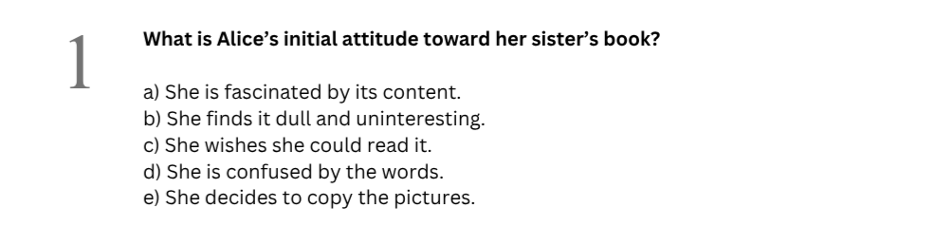
These questions require children to read between the lines, working out what a character feels, what the author implies or how a description creates atmosphere. A question might ask: How is the boy feeling in this moment? or, Which phrase from the text best shows the boy’s nervousness?
If it’s multiple-choice, there’s no room for error. If you’re facing long-form answers, the best responses link inference directly to textual evidence: “The boy is nervous, shown by the phrase ‘his hands trembled as he reached for the door.’”
Here’s a sample question, alongside an extract from the comprehension passage. Which answer is correct?

- Explicit information questions
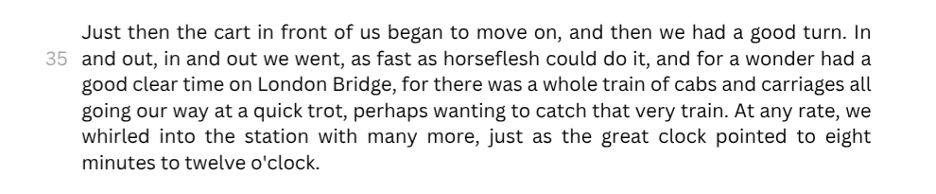
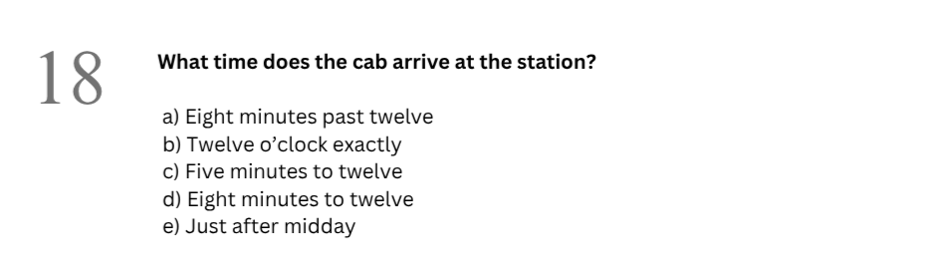
Sometimes, it really is about finding information in black and white. These “retrieve and recall” questions can trip children up if they rush, especially if several similar details appear in the text.
- Vocabulary and word class questions
Your child might be asked to define a tricky word (synonyms and antonyms are particular favourites) or identify the word class of a word as used in a sentence (for instance, a proper noun or a determiner). Examiners favour words with different nuances or uses depending on the context.
This is why a rich vocabulary, built through wide reading and consistent practice, is so important. (If you haven’t already, our 11 Plus Reading List is a good place to start.)
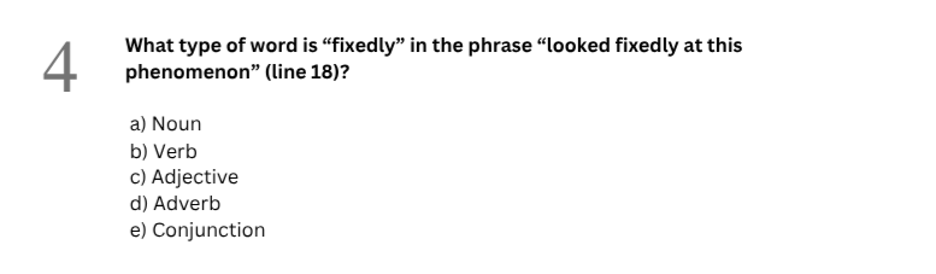
Although word class questions often feature in comprehension papers, we’ve also created bespoke SPaG-only 11+ practice papers. These include spelling, punctuation, sentence completion and word class sections, so your child can hone these skills.
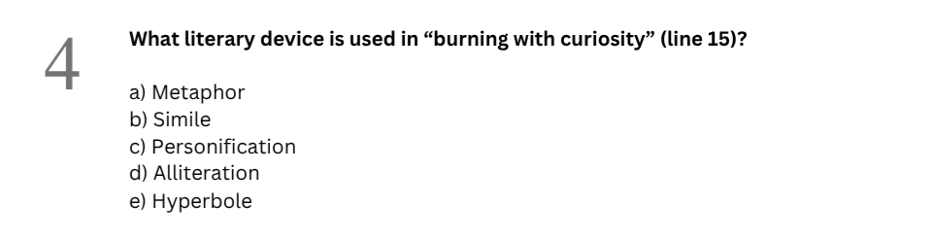
- Figurative language questions
Similes, personification, alliteration and onomatopoeia. 11+ examiners love all types of language techniques. But it’s not enough to spot them. Children must also explain their effect.
In multiple-choice, they might pick from options explaining why an author chose a particular description. In long-form answers, it’s all about putting this in your own words. For example: “The simile ‘buzzing like a hive’ suggests the marketplace was noisy, busy, and full of life.”
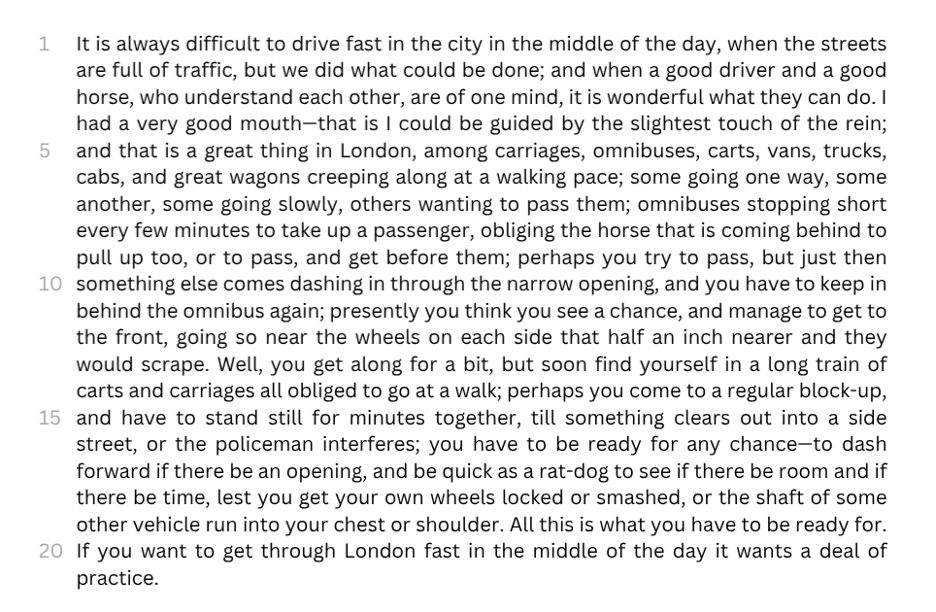
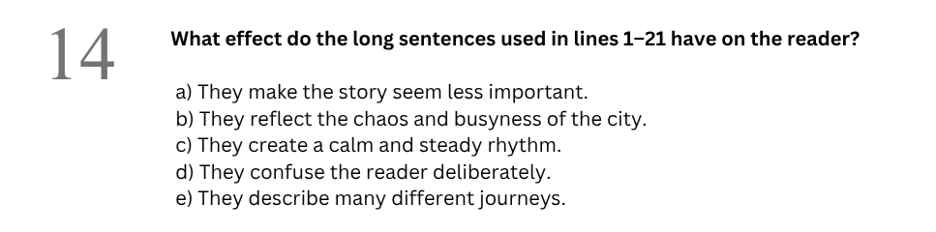
- Structure and style questions
More advanced but increasingly common, these questions ask about how a writer creates tension, shifts pace, creates atmosphere or uses dialogue. They reward children who are confident with the nuances of advanced literary texts, which is why practising with a range of passages matters.
Don’t forget: Most grammar schools include creative writing or dedicated SPaG sections as part of their 11+ English exams. So as well as comprehension, it’s worthwhile getting a head start on these core skills.
How Do Children Learn Comprehension?
Strong comprehension doesn’t come from endless past papers (although practice materials certainly have their place!). It’s built gradually, through layering skills.
The starting point is vocabulary: children who read widely and absorb new words are far more confident tackling complex texts. Alongside this, grammar knowledge helps enormously. Understanding word classes, sentence typesand punctuation gives children the tools to explain how writers achieve effects.
The next layer is inference, which is less about knowledge and more about thinking habits. Some children naturally ask “why” questions as they read, but others need to be explicitly taught. Pausing mid-passage to discuss: Why do you think the character is doing this? Why did the author pick that word? What clues give it away? builds this instinct.
And then, of course, there’s practice. The more varied the texts your child encounters (classic novels, modern stories, newspaper articles, leaflets), the better prepared they’ll be for whatever examiners throw at them.This is why we created our 11 Plus Mock Tests. They expose children to the style, pace and pressure of the real exam, in a safe and supportive environment.
How to Teach Kids to Answer Comprehension Questions
Once the foundations are in place, the next challenge is teaching children how to translate those skills into exam performance. Parents often ask: How should I actually teach comprehension at home? The truth is, it’s not about drilling them with question after question. It’s about showing them a process, practising it step by step, and making sure it feels achievable rather than overwhelming.
What are the “Super Six” comprehension strategies?
Let’s start with the strategy.
Teachers often talk about the “Super Six” comprehension strategies, and they’re just as useful for 11+ prep as they are in the classroom. These six aspects encourage active reading and build the advanced thinking habits examiners want to see.
- Predicting: Before reading, ask your child what they think the passage might be about.
- Visualising: Encourage them to picture scenes in their head. It makes figurative language questions easier.
- Making connections: Relating a passage to something they’ve read before or real-life experiences deepens understanding.
- Questioning: Get them in the habit of asking “why did the author write it like this?”
- Clarifying: Don’t skip past tricky words. Pause and pin down their meaning.
- Summarising: At the end, challenge your child to explain the passage in two or three sentences.
How do you teach comprehension step by step?
Teaching comprehension is very much like teaching a child to ride a bike. You don’t throw them straight on a racing bike and hope for the best. You start with stabilisers, run alongside for a while, and only gradually let go once they’ve built balance and confidence. The same principle applies here: comprehension isn’t a single skill, it’s a sequence of habits that need scaffolding at first, before your child can use them independently under exam conditions.
The best approach is building progression into practice: short texts before long ones, supported discussion before independent answers, accuracy before speed. By layering these stages, you help your child feel in control of the process. And children who feel in control are far more likely to produce high 11+ scores.
Here’s a step-by-step 11+ progression that works:
- Start small: Use short extracts (a paragraph or two) and focus on just one or two question types, like inference or vocabulary.
- Model answers together: Read a question aloud, think it through together, and show how to back up an answer with a quote.
- Move to guided practice: Let your child answer with prompts (“What word tells us he was nervous?”) before expecting full independence.
- Build towards timing gradually: Begin untimed so accuracy can settle, then slowly shorten the clock.
- Refine for quality: Praise concise, evidence-based answers rather than long retellings. A short, sharp explanation with a clear quote is far more effective than a rambling paragraph.
This gradual approach stops children feeling overwhelmed and ensures the right habits become second nature.
How can you teach comprehension in a fun way?
Last but not least, making things fun is important!
For many families, comprehension has a reputation as the “boring” part of English. But it doesn’t need to be that way. In fact, the more fun you make comprehension, the more likely it is to stick. Fun takes the pressure off, encourages curiosity, and keeps children engaged with texts in a way that rote drills can’t.
The key is weaving comprehension skills into playful, interactive activities so your child practises inference, vocabulary and summarising without realising it. Not only does this boost engagement, but it also helps children see reading as enjoyable.
Tried-and-tested fun methods
- Role-play a passage: Take on different characters’ voices, then pause to ask, “How is she feeling right now?”
- Comic strip the story: Summarising visually is brilliant for distilling key details.
- Language hunt: Challenge your child to spot similes, metaphors, or adjectives. Make it a competition if you like.
- Quiz show format: Parent asks questions; child has 30 seconds to “buzz in” with an answer.
- Paired reading: Take turns reading paragraphs aloud, then fire quick “why” or “how” questions at each other.
By keeping it playful and varied, you shift comprehension from a task children have to do into something they’re genuinely engaged by. And that change in attitude can make all the difference when they’re faced with a demanding passage in the exam hall.
Final Thoughts: How to Ace Comprehension for 11+ Exams
If there’s one message to take away, it’s this: comprehension is both the hardest and the most rewarding part of the 11+. Hardest, because it tests deep skills that can’t be crammed at the last minute. Most rewarding, because once mastered, those skills carry children far beyond the exam hall.
The path to success isn’t mysterious. Build vocabulary and grammar, practise the five core question types, use the “Super Six” strategies, and teach step by step. Keep it engaging, keep it consistent, and your child will walk into their exam ready to face whatever passage lands on the desk.
At Achieve Learning, we’ve helped countless children secure places at some of the most competitive schools in the country. Again and again, we see the families who focus on comprehension early (and teach it step by step) give their children a real edge.
We offer expert 11+ tuition, tailored mock exams and academic consultancy to check everything’s on track. Together, we’ll ensure your child has the skills and confidence to succeed.


